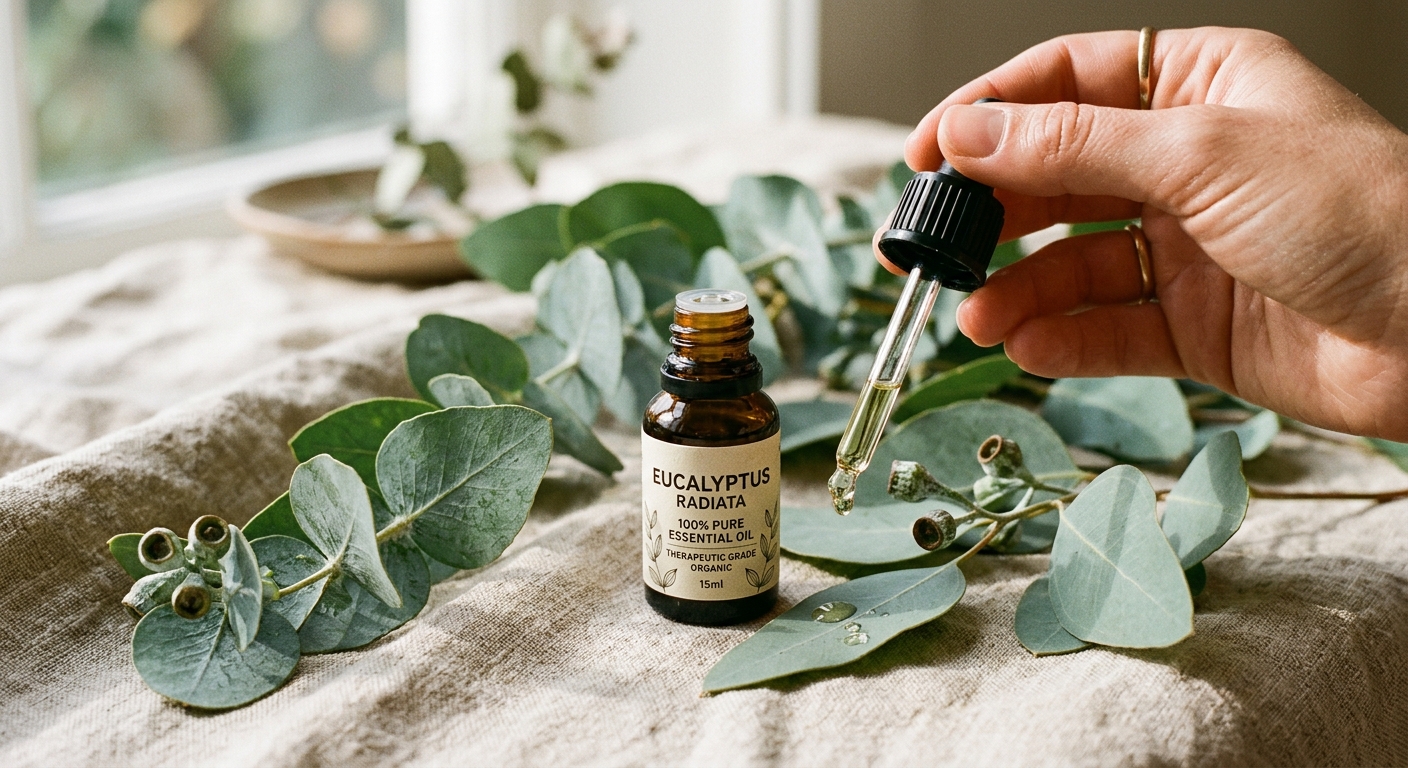
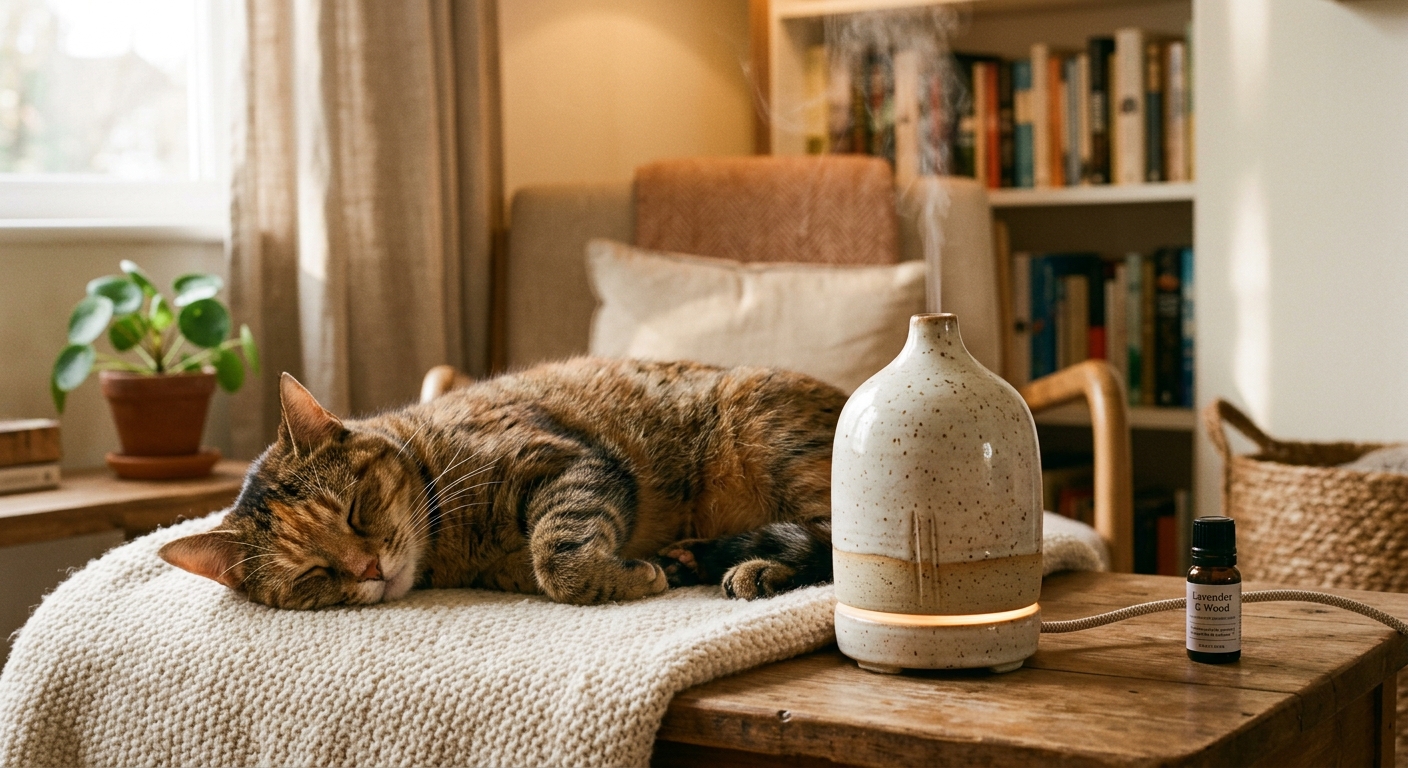
If you’ve searched “cat safe essential oils,” you’ve probably been told that lavender, cedarwood, frankincense, Roman chamomile, and sandalwood are the “lower-risk” picks. The honest version of that answer is more uncomfortable.
No essential oil has a peer-reviewed cat-specific safety study supporting an unconditional “safe” designation. The most permissive expert position — Robert Tisserand’s — says “a small amount of any essential oil, and a moderate amount of most, will not harm your cat. However, cats are quite susceptible to toxicity from nutmeg oil and tea tree oil.” That is reasoning from chemistry, not from a controlled feline trial.
Worse, two oils widely promoted as “cat-safe” — Roman chamomile and sandalwood — are actually classified as toxic to cats by ASPCA-aligned vet sources. The genuinely cat-safer route is to skip essential oils entirely and use evidence-backed alternatives.
The two tables below do exactly that. The first corrects the common “lower-risk oils” claim with the honest classification. The second ranks 14 cat-safer scent alternatives by how strong the evidence actually is — from peer-reviewed primary feline data down to vendor self-claims.
The 5 “lower-risk” essential oils — corrected
Designation key. TOXIC = ASPCA-aligned vet sources classify the oil as toxic to cats. MODERATE-RISK = better tolerated than most but still on the ASPCA toxic list. LOWER-RISK* = chemistry-based inference (low phenol content) plus government primary tox data; the asterisk flags that no peer-reviewed feline trial exists, even where there is government rat/mouse data.
| # | Oil | Botanical name | Honest designation | Why | Primary citation |
|---|---|---|---|---|---|
| 1 | Lavender | Lavandula angustifolia | MODERATE-RISK on the ASPCA toxic list, but better tolerated than most | Linalool / linalyl acetate; lower phenol content; no peer-reviewed cat trial. | Pet Poison Helpline |
| 2 | Cedarwood (Virginia / Texas) | Juniperus virginiana, J. ashei | LOWER-RISK* phenol-free chemistry + government primary tox data (rats/mice) | α-cedrene, β-cedrene, thujopsene, cedrol — no phenols. Atlas cedarwood (Cedrus atlantica) is treated more cautiously. | NIH NTP Technical Report; EFSA 2024 |
| 3 | Frankincense | Boswellia carterii / B. sacra / B. serrata | LOWER-RISK* by chemistry; not recommended for direct cat use | No significant phenols; no peer-reviewed cat trial; vet-reviewed sources advise against direct application. | Catster vet-reviewed |
| 4 | Roman chamomile | Chamaemelum nobile | TOXIC corrects the common "lower-risk" classification | Anthemic acid, bisabolol, chamazulene, tannic acid + volatile oil; can cause chemical burns, kidney/liver damage, liver failure. | ASPCA Toxic Plants; Catster vet-reviewed |
| 5 | Sandalwood | Santalum album / S. spicatum | TOXIC corrects the common "lower-risk" classification | Santalols are sesquiterpene alcohols cats can't metabolize; documented vomiting, diarrhea, lethargy, liver damage; no antidote. | Catster vet-reviewed; Hepper vet-reviewed |
14 cat-safer scent alternatives, ranked by evidence
Evidence tier key. PEER-REVIEWED PRIMARY = controlled feline study. ASPCA-VETTED = ASPCA APCC has explicitly evaluated the product/plant. INDUSTRY-VERIFIED = engineering or chemistry data, not feline-specific. TISSERAND-RECOMMENDED = expert aromatherapy consensus. POPULAR PRACTICE = common household practice with caveats. VENDOR CLAIM = manufacturer claim, no independent feline study. WIDELY-RECOMMENDED = consistently recommended across reputable consumer sources.
| # | Alternative | Category | Evidence tier | Why it's cat-safer | Primary citation |
|---|---|---|---|---|---|
| 1 | Silvervine (Actinidia polygama) | Cat-attractive aromatic enrichment plant | PEER-REVIEWED PRIMARY | ~80% of domestic cats respond positively; GRAS for cats and humans. | Bol et al. 2017, BMC Vet Res |
| 2 | Catnip (Nepeta cataria) | Cat-attractive aromatic enrichment plant | PEER-REVIEWED PRIMARY | ~67% response rate; GRAS for cats and humans. | Bol et al. 2017 |
| 3 | Valerian root (Valeriana officinalis) | Cat-attractive aromatic enrichment plant | PEER-REVIEWED PRIMARY | ~50% response rate; effective for many catnip non-responders. | Bol et al. 2017 |
| 4 | Tatarian honeysuckle (Lonicera tatarica) | Cat-attractive aromatic enrichment plant | PEER-REVIEWED PRIMARY | ~50% response rate; GRAS. | Bol et al. 2017 |
| 5 | Febreze | Commercial fragrance / odor neutralizer | ASPCA-VETTED | ASPCA APCC: safe in households with cats and dogs when used as directed; phthalate-free; dipropylene glycol carrier. Not for use around birds. | NAIA — ASPCA APCC consultation |
| 6 | Boston fern (Nephrolepis exaltata) | Cat-safe air-purifying houseplant | ASPCA-VERIFIED | Non-toxic to cats and dogs; adds humidity. | ASPCA non-toxic plants |
| 7 | Spider plant (Chlorophytum comosum) | Cat-safe air-purifying houseplant | ASPCA-VERIFIED | Non-toxic; removes formaldehyde, xylene, toluene. May attract cats to chew (mild, no systemic toxicity). | ASPCA non-toxic plant list |
| 8 | HEPA + activated-carbon air purifier | Air filtration / odor control | INDUSTRY-VERIFIED | HEPA captures particles, activated carbon adsorbs VOCs and ammonia. HEPA alone is not effective for pet odors. | Molekule; Alen |
| 9 | Activated charcoal pouches | Passive odor adsorber | INDUSTRY-VERIFIED | Porous carbon adsorbs ammonia and VOCs; fragrance-free; no ingestion risk if placed out of reach. | Alen |
| 10 | Baking soda (sodium bicarbonate) | Passive odor adsorber | WIDELY-DOCUMENTED | Adsorbs odor molecules; non-toxic at quantities used; sprinkle in litter box or use as open container. | Alen |
| 11 | 100% beeswax / soy candle (unscented, cotton/wood wick, no EOs) | Ambient candle | INDUSTRY-VERIFIED | Avoids the three biggest cat hazards in candles: paraffin combustion byproducts, essential oils, and phthalate fragrance carriers. | Tomlinson's Feed; Northumbrian Candleworks |
| 12 | Hydrosols (lavender, German chamomile, rose) | Aqueous distillate | TISSERAND-RECOMMENDED | Water-soluble distillate fraction; far lower concentration than EOs. Avoid hydrosols of plants whose EOs are highly toxic (tea tree, pennyroyal, wintergreen, sweet birch). | Robert Tisserand 2011; Essential 3 |
| 13 | Simmer pot (cat-safe ingredients only) | Stovetop ambient scent | POPULAR PRACTICE | Low-simmering aromatic water; concentration is far below diffuser EO levels. Never add essential oils. Avoid concentrated cinnamon sticks and large amounts of citrus peel — those plants' EOs are cat-toxic. Lower-risk: apple peels, vanilla bean, mint leaves in small amounts. | Preventive Vet |
| 14 | Open windows / cross-ventilation | Mechanical air exchange | WIDELY-RECOMMENDED | Replaces stale air with fresh; the most consistently top-voted recommendation across veterinary and consumer sources. Use screens; avoid trapping cats with strong smells. | EveryCat Health Foundation |
Why cats are uniquely vulnerable
Cats are deficient in the liver enzyme UDP-glucuronyltransferase (UGT), which most mammals use to conjugate phenols, monoterpenes, and other lipophilic xenobiotics for excretion. Without that pathway, those compounds accumulate after dermal, oral, or inhaled exposure. Cats also self-groom — ingesting any residue on their fur — and their proportionally smaller respiratory volumes make airborne micro-droplets a more concentrated dose per body weight than in dogs or humans. The 21-oil cat toxicity reference breaks down the specific compound — terpinen-4-ol, methyl salicylate, eugenol, pulegone, and the rest — that does the damage in each high-risk oil.
Source: Merck/MSD Veterinary Manual; Texas A&M VMBS; Pet Poison Helpline (cross-verified).
The only peer-reviewed primary source for cat-aromatic enrichment
In a 2017 BMC Veterinary Research study, Sebastiaan Bol and colleagues tested 100 domestic cats and 9 cats from 4 wild felid species. About 80% of cats responded to silvervine (Actinidia polygama), about 67% to catnip, and about 50% to valerian and Tatarian honeysuckle. All four plants are “generally regarded as safe and nontoxic for cats and humans.”
That makes silvervine, catnip, valerian, and Tatarian honeysuckle the only category of cat-aromatic enrichment with peer-reviewed primary feline data. Every other “cat-safe” scent designation in this article rests on chemistry inference, vendor self-testing, or expert consensus — not feline RCTs. That’s worth knowing before you spend money on a “pet-safe” diffuser.
Source: Bol S, Caspers J, Buckingham L, et al. BMC Veterinary Research 2017;13:70.