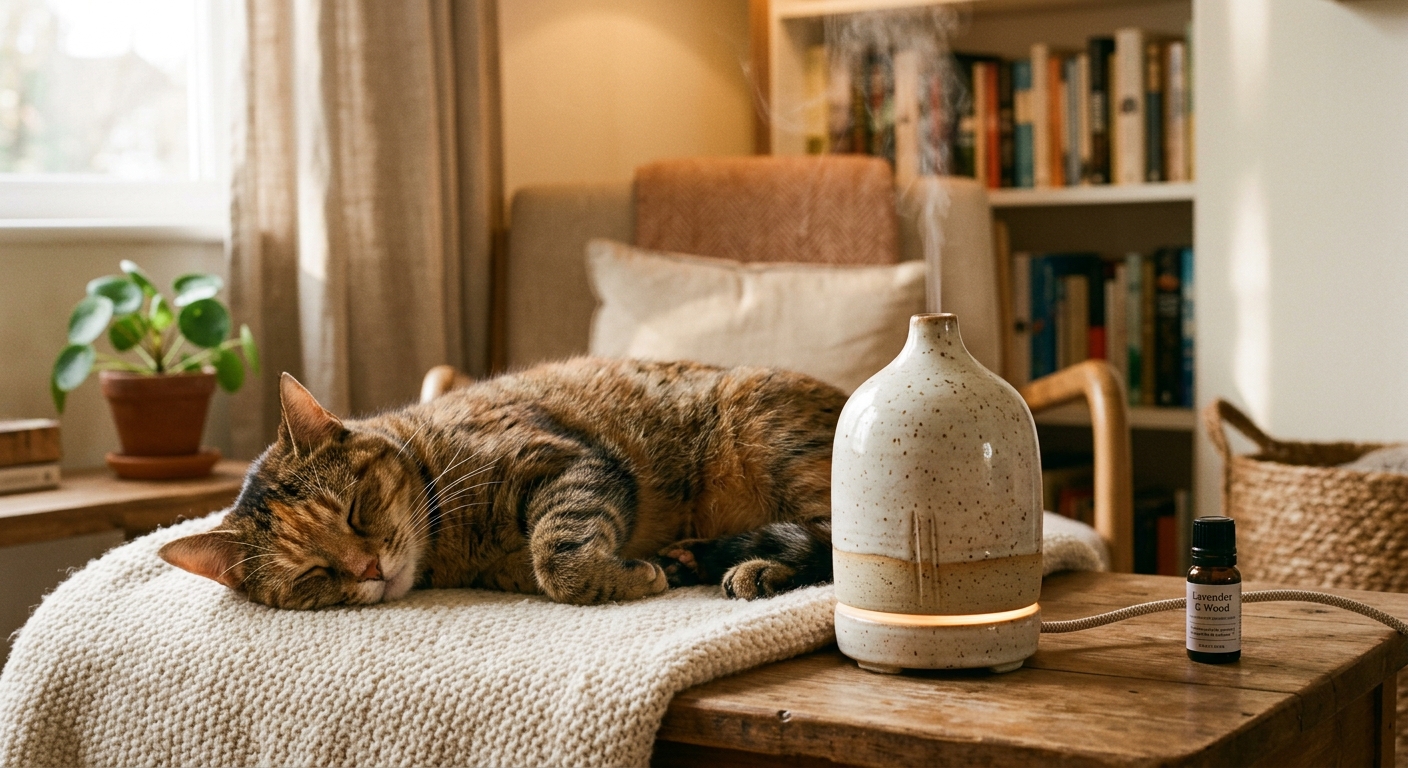
If you have a cat in the house, the safest assumption about any essential oil is “treat it as a drug, not a wellness product.” Cats are missing the liver enzyme — UDP-glucuronyltransferase, or UGT — that most other mammals use to break down phenols and monoterpenes. Without that pathway, compounds that we metabolize and excrete just accumulate in their tissues. Add in self-grooming (any oil residue on fur ends up ingested) and a small body weight (a “trace amount” by human standards is a meaningful dose for a 4-kg animal), and the risk profile shifts dramatically.
The table below is a sortable, severity-ranked reference for the 21 essential oils that come up most often in pet-poisoning calls and household exposures. Each row carries a primary-source citation — peer-reviewed case series, Merck Vet Manual, ASPCA APCC, NIH LiverTox monographs, or Pet Poison Helpline veterinary education materials. If you’re looking for what to use instead of essential oils around cats, the companion guide on cat-safer scent alternatives ranked by evidence covers 17 options — from peer-reviewed primary feline data (silvervine, catnip) down to vendor-claim diffusers.
Master toxicity table — 21 oils
Key. Severity = SEVERE (potentially fatal), HIGH, MODERATE-HIGH, MODERATE-RISK, LOWER-RISK*. Exposure-route risk = low, moderate, high, very high. Asterisk (*) on LOWER-RISK = no peer-reviewed cat-specific safety study; designation is based on chemistry inference (low phenol content) and aromatherapy expert consensus.
| # | Oil (common name) | Botanical name | Primary toxic compound | Severity tier | Diffused | Topical | Ingested | Primary citation |
|---|---|---|---|---|---|---|---|---|
| 1 | Tea tree | Melaleuca alternifolia | Terpinen-4-ol, 1,8-cineole, monoterpenes | SEVERE | high | very high | very high | Khan et al. 2014, JAVMA |
| 2 | Pennyroyal | Mentha pulegium | Pulegone (→ menthofuran metabolite) | SEVERE | high | very high | very high | NIH LiverTox — Pennyroyal |
| 3 | Wintergreen | Gaultheria procumbens | Methyl salicylate (~98%) | SEVERE | moderate-high | very high | very high | Pet Poison Helpline / Veteriankey |
| 4 | Sweet birch | Betula lenta | Methyl salicylate | SEVERE | moderate-high | very high | very high | Merck Vet Manual |
| 5 | Sassafras | Sassafras albidum | Safrole | SEVERE (probable carcinogen) | high | high | very high | NIH 15th Report on Carcinogens |
| 6 | Camphor | Cinnamomum camphora | Camphor (bicyclic monoterpene ketone) | SEVERE (neurotoxic) | high | high | very high | PMC10658210 case report |
| 7 | Cinnamon | Cinnamomum cassia / C. verum | Cinnamaldehyde, eugenol, coumarin | HIGH | moderate | high | high | ASPCA APCC classification |
| 8 | Clove (and clove-bud) | Syzygium aromaticum | Eugenol | HIGH | moderate | high | very high | NIH LiverTox — Eugenol |
| 9 | Pine | Pinus sylvestris and other Pinus spp. | α-pinene, β-pinene, terpene alcohols | HIGH | moderate-high | high | very high | Pet Poison Helpline |
| 10 | Thyme | Thymus vulgaris | Thymol (phenolic monoterpene) | HIGH | moderate-high | high | very high | Frontiers in Vet Sci 2025 |
| 11 | Oregano | Origanum vulgare | Carvacrol + thymol | HIGH | moderate-high | high | very high | MDPI Antibiotics 2023 |
| 12 | Roman chamomile | Chamaemelum nobile (= Anthemis nobilis) | Anthemic acid, bisabolol, chamazulene, tannic acid + volatile oil | HIGH corrects the common "lower-risk" claim | moderate | high | high | ASPCA Toxic Plants; Catster vet-reviewed |
| 13 | Sandalwood | Santalum album / S. spicatum | Santalols (sesquiterpene alcohols cats can't metabolize) | HIGH corrects the common "lower-risk" claim | moderate | high | high | Catster vet-reviewed; Hepper vet-reviewed |
| 14 | Citrus / d-limonene (lemon, orange, grapefruit, lime, bergamot, mandarin, tangerine) | Citrus limon, C. sinensis, C. paradisi, C. aurantifolia, C. bergamia, C. reticulata | d-Limonene; linalool (bergamot) | MODERATE-HIGH | moderate | high | high | Hooser 1986/1990 |
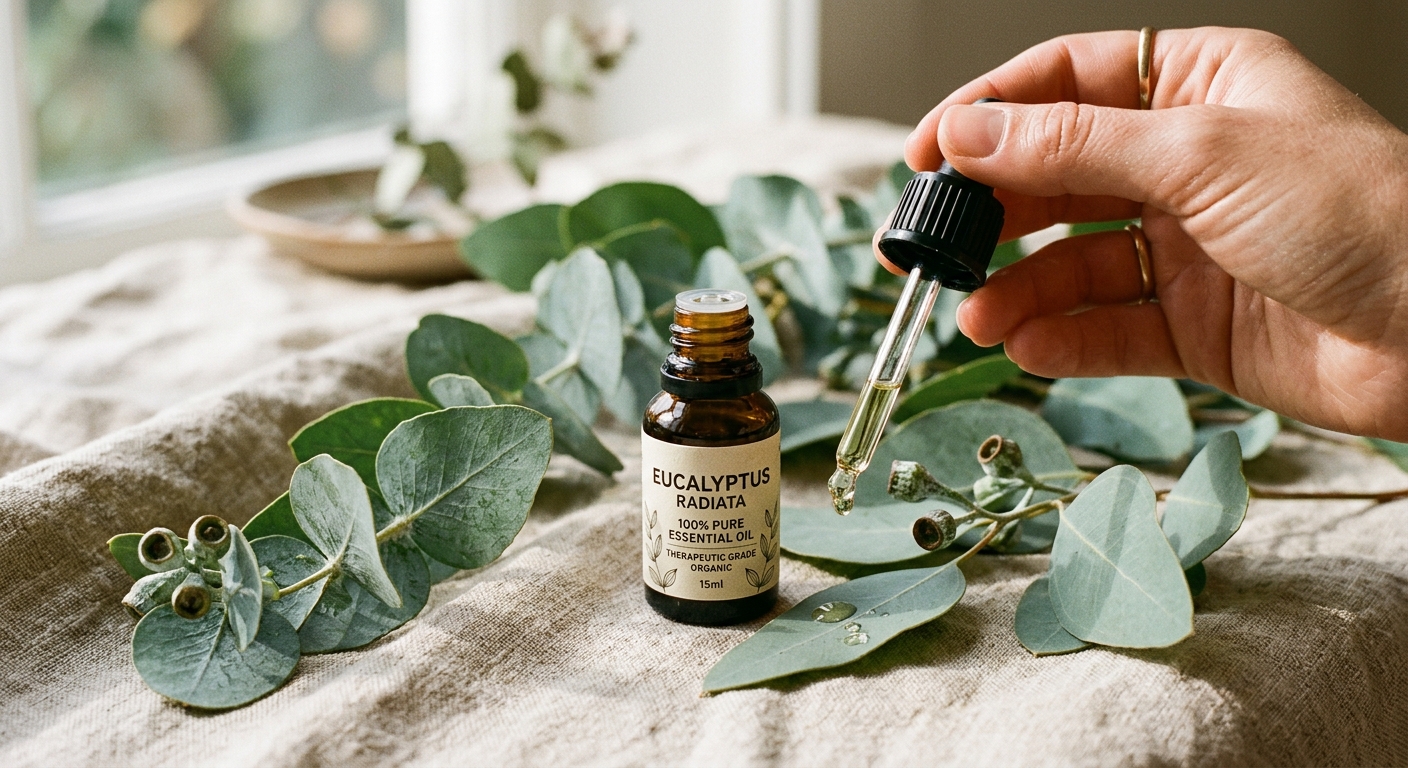
| 15 | Eucalyptus | Eucalyptus globulus, E. radiata, E. citriodora | 1,8-cineole (eucalyptol), α-pinene | MODERATE-HIGH | moderate-high | high | high | Pet Poison Helpline |
| 16 | Peppermint | Mentha piperita | Menthol, menthone, pulegone (trace), 1,8-cineole | MODERATE-HIGH | moderate | moderate-high | high | Am. College of Vet. Pharmacists |
| 17 | Ylang-ylang | Cananga odorata | Sesquiterpenes, linalool, geranyl acetate | MODERATE-HIGH | moderate | high | high | Pet Poison Helpline |
| 18 | Neem (margosa) | Azadirachta indica | Azadirachtin and other limonoids | MODERATE-HIGH | low-moderate | moderate-high | high | Sudekum et al. 2009 |
| 19 | Lavender | Lavandula angustifolia | Linalool, linalyl acetate | MODERATE-RISK on the ASPCA toxic list, but better tolerated than most | low-moderate | moderate-high | high | Pet Poison Helpline / ASPCA |
| 20 | Cedarwood (Virginia / Texas — phenol-free) | Juniperus virginiana, J. ashei | Cedrol, thujopsene (no phenols in these species) | LOWER-RISK* | low | low-moderate | moderate | NIH NTP Technical Report; EFSA 2024 |
| 21 | Frankincense | Boswellia carterii / B. sacra / B. serrata | Boswellic acids (no significant phenol content) | LOWER-RISK* | low-moderate | moderate | moderate-high | Catster vet-reviewed |
* LOWER-RISK rows have no peer-reviewed cat-specific safety study. The designation is based on chemistry inference (low phenol content) and aromatherapy expert consensus. They are not flagged on the ASPCA toxic-essential-oils list, but no controlled feline trial supports an unconditional "safe" label.
Why cats are uniquely vulnerable
Cats are deficient in the liver enzyme UDP-glucuronyltransferase (UGT), which most mammals use to conjugate phenols, monoterpenes, and other lipophilic xenobiotics for excretion. Without that pathway, these compounds accumulate after dermal, oral, or inhaled exposure.
Two compounding factors make the dose-by-weight even worse than the metabolic gap suggests:
- Self-grooming. Any oil residue that lands on a cat’s fur is licked off and ingested. A “topical only” exposure is usually a topical plus oral exposure for a cat.
- Smaller respiratory volumes. Airborne micro-droplets from a diffuser are a more concentrated dose per kilogram of body weight in a 4 kg cat than in a 10 kg dog or a 70 kg human.
Source: Merck/MSD Veterinary Manual; Texas A&M VMBS; Pet Poison Helpline; VCA Animal Hospitals (cross-verified).
What to do if your cat is exposed
- Move the cat to fresh air immediately.
- Identify the oil — find the bottle so the vet can identify the specific compound.
- Do NOT induce vomiting — aspiration risk for terpene-heavy oils, seizure risk for camphor and wintergreen.
- Do NOT bathe with shampoo if oil is on the skin. For some compounds, bathing increases dermal absorption. Use a soft cloth with mild soap to remove visible residue if exposure is recent and limited.
- Call Pet Poison Helpline (855-764-7661) or ASPCA Animal Poison Control (888-426-4435) — both charge a fee.
- Seek veterinary care immediately even before symptoms appear. There is no antidote; treatment is supportive (fluids, hepatoprotectants like NAC and SAMe, anticonvulsants, oxygen).
Source: Pet Poison Helpline; VCA Animal Hospitals; Merck/MSD Veterinary Manual; LiverTox monographs (cross-verified).
Once everyone’s safe, the practical next question is what to actually use in the house going forward. The genuinely cat-safer route is to skip essential oils entirely and use evidence-backed alternatives — see the 17 cat-safer scent options ranked by evidence tier for what’s been studied, what’s chemistry-inferred, and what’s vendor-claim.